

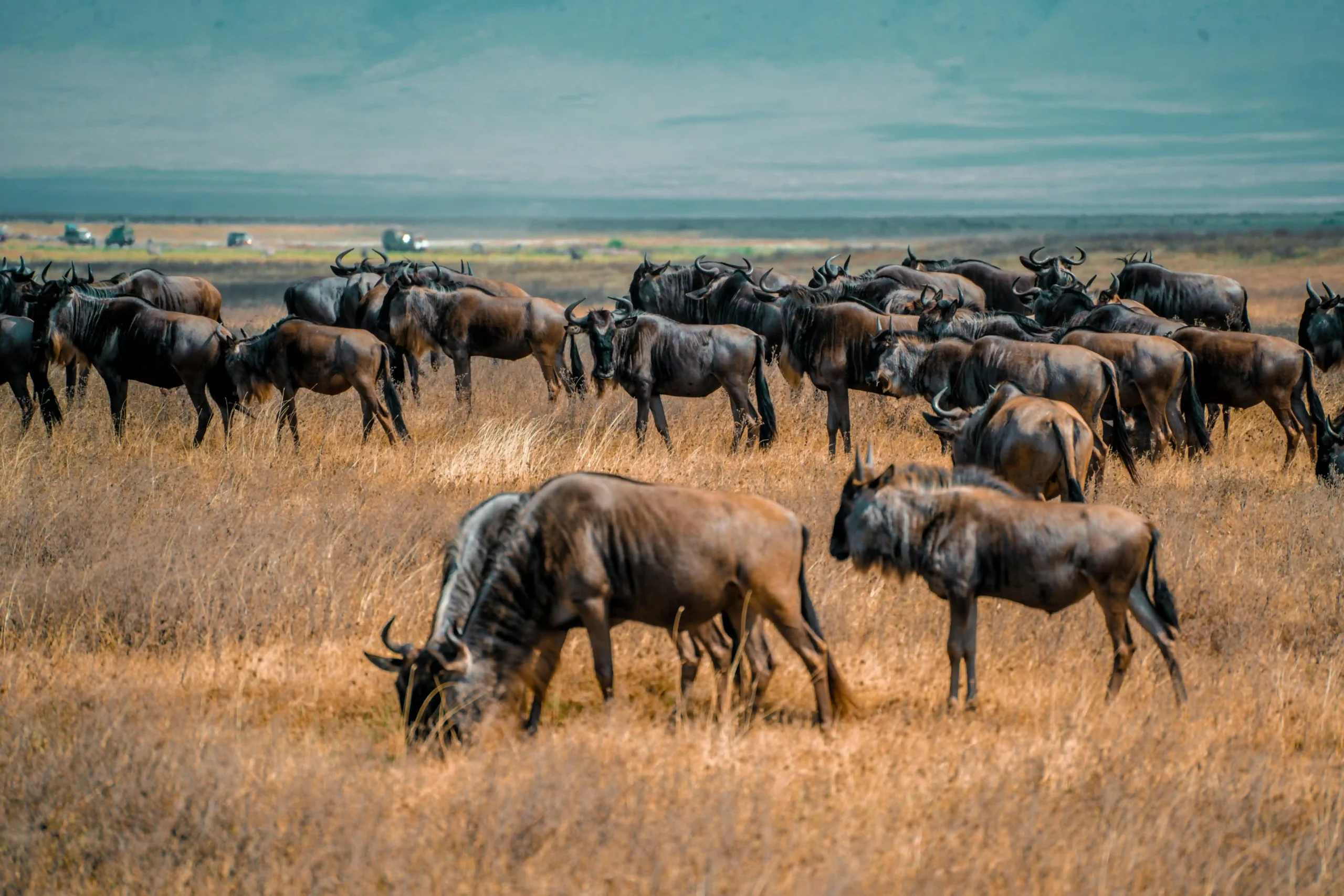
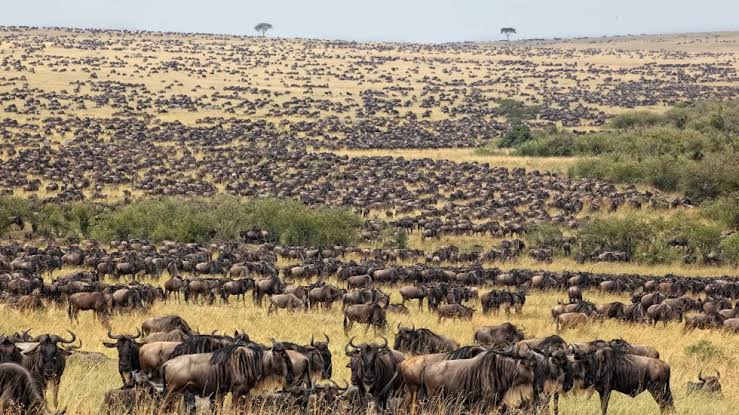
Wildebeest crossing the Mara River during a great migration safari in the Northern Serengeti.
A great migration safari also called a wildebeest migration safari, Serengeti migration safari, or Tanzania migration tour is a wildlife journey through Tanzania's Serengeti ecosystem, timed to intercept the Great Wildebeest Migration: the continuous, year-round movement of roughly two million wildebeest, zebra, and gazelle following the rains in a clockwise circuit. There is no single "migration season"; instead, different chapters of the journey calving, river crossings, and the northward and southward push happen in different months, so the best time for a great migration safari depends on what a traveler most wants to witness.
Just before sunrise on the Ndutu plains, the grass is silver with dew and the horizon has no edges. A lion coughs somewhere in the dark. Then, as the light turns gold, the plains simply start moving thousands of wildebeest rising at once, as if the earth itself had exhaled. This is not a staged moment. It happens most mornings, in one part of the country or another, all year long and it is the reason a great migration safari sits at the very top of most travelers' lifetime wildlife lists. National Geographic describes a perfect Serengeti morning as one that might begin with a sunrise balloon flight over the plains, followed by a game drive threading through herds of wildebeest on the way back to camp.
A great migration safari is a guided safari built around one specific goal: putting travelers in the right place, at the right time, to witness the Great Wildebeest Migration in Tanzania's Serengeti. According to National Geographic, more than a million wildebeest, along with countless zebras and gazelles, follow the rains across the Serengeti-Mara ecosystem in a relentless quest for greener pastures, making this one of the largest and most closely tracked wildlife movements on the planet.
Unlike a standard national-park safari with a fixed route, a great migration safari is dynamic the itinerary bends around where the herds currently are, which means the best operators adjust routing week to week rather than locking in a rigid plan months in advance.
Key facts about the Great Migration, at a glance:
This is the single most misunderstood fact about a great migration safari: the migration is not an annual event with a clear start and finish. It is a continuous circuit, and travelers can join a great migration safari at almost any point in the year and still witness a meaningful chapter of the story.
Herds gather on the short-grass plains, where over 500,000 wildebeest calves are born within a few concentrated weeks. This period draws dense predator activity, as lion, cheetah, and hyena capitalize on the vulnerable newborns.
As the southern plains dry out, the herds begin moving north, splitting through the Moru Kopjes and into the Western Corridor toward the Grumeti River.
The first major river obstacle of the year. Fewer crowds than the Mara crossings, but the same crocodile laced drama.
The most famous and most photographed chapter of any great migration safari thousands of wildebeest plunging into the Mara River in a single chaotic surge.
As the short rains begin, the columns turn back toward the southern plains, restarting the cycle in time for the next calving season.
There is no universally "best" month for a great migration safari only the best month for a specific kind of experience. A useful way to decide:
Because the migration never truly stops, a well-timed great migration safari can intercept it in a different, equally dramatic form almost any month of the year.
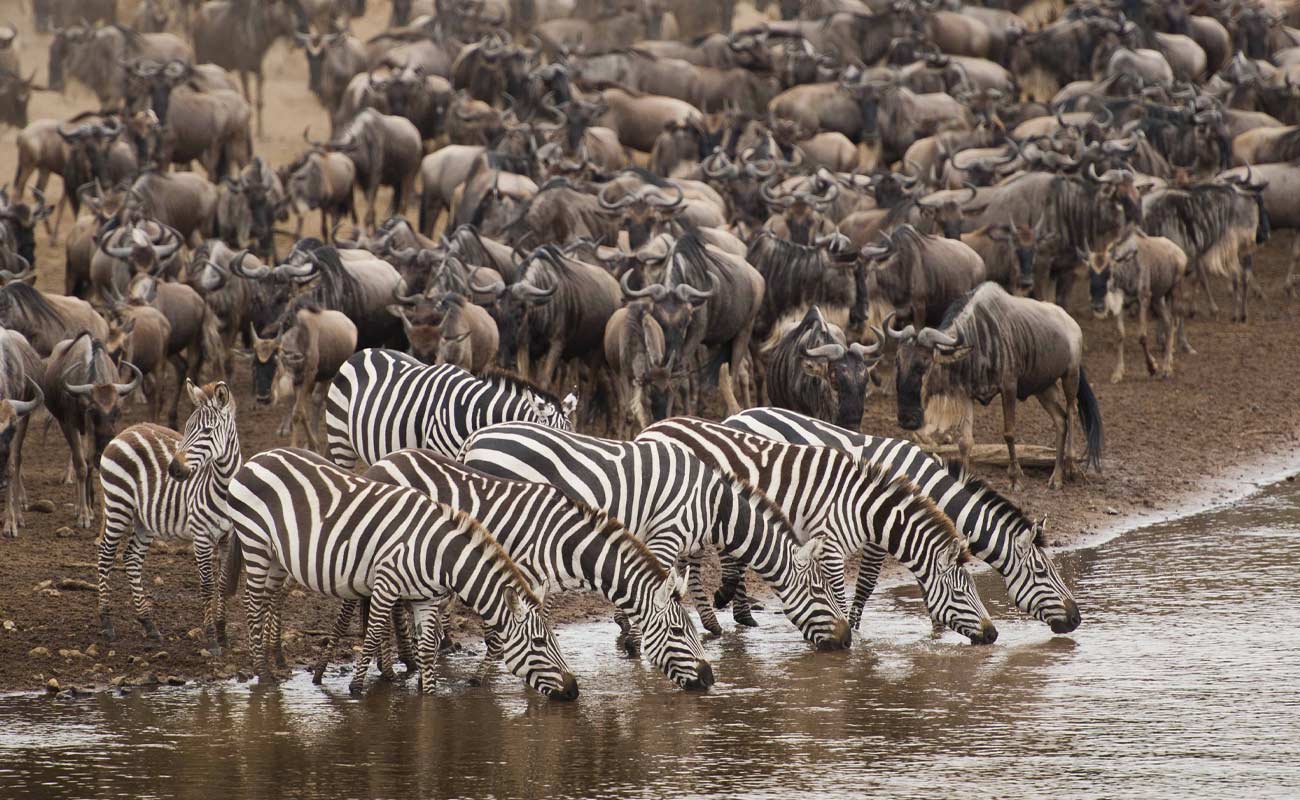
The Serengeti's unfenced plains give a great migration safari room to move with the herds.
Tanzania hosts the largest and least crowded share of the migration circuit. The Serengeti-Ngorongoro-Maswa-Loliondo landscape spans more than 30,000 square kilometres of largely unfenced wilderness a scale that means a Serengeti migration safari here rarely feels bottlenecked, even during peak crossing season.
This scale is also why UNESCO has designated Serengeti National Park a World Heritage Site, citing the annual migration to permanent water holes of vast herds of wildebeest, gazelles, and zebras as one of the most impressive natural events in the world. The African Wildlife Foundation further notes that the Serengeti's wildebeest population migrates 800 to 1,610 kilometres in a single circuit each year the scale of movement that makes a flexible, real-time approach essential for any Tanzania wildebeest migration safari.
Tanzania also allows a great migration safari to be combined, within a single itinerary, with several of Africa's other headline destinations:
A luxury great migration safari typically combines the following elements:
Operators such as Glad Of Africa Safari & Tours build their Migration Safaris collection specifically around this level of flexibility, with guides who track the herds daily and shape each itinerary including specialist trips like the 7-Day Ndutu Calving Season Safari — around where the migration actually is, rather than where it was expected to be.
Both countries offer access to the same overall ecosystem, but the experience differs:
| Factor | Tanzania (Serengeti) | Kenya (Maasai Mara) |
|---|---|---|
| Scale | Much larger, less crowded | Smaller, more concentrated |
| Migration coverage | Full annual circuit, including calving grounds | Primarily the northern crossing stage |
| Infrastructure | More remote, private-concession heavy | Closer to Nairobi, well-developed |
| Crowding at crossings | Lower, due to larger unfenced area | Higher, due to smaller geographic footprint |
Neither country is objectively "better" the choice depends on whether a traveler wants the full annual story (Tanzania) or a shorter, more accessible trip focused on the crossing season (Kenya).
Not exactly. A standard Serengeti safari focuses on the park's resident wildlife year-round. A great migration safari is specifically planned and routed around the current location of the migrating herds, which changes month to month.
Yes. Because it is a continuous circuit rather than a single seasonal event, a great migration safari can be planned for almost any month the experience simply changes character depending on the season (calving, river crossings, or the northward/southward push).
The Mara River crossings, typically occurring between July and September in the Northern Serengeti, where large groups of wildebeest plunge into crocodile-inhabited water in a single dramatic surge.
Yes. Tanzania's northern safari circuit is a short flight from Zanzibar, making it straightforward to combine a great migration safari with several days of beach and cultural time in Stone Town.
For peak Mara River crossing season (July–September), yes availability at well-located camps is limited and often books a year or more ahead. Calving season (January–March) and the shoulder months typically offer more flexibility.
The single biggest factor separating an unforgettable great migration safari from a merely good one is guiding quality specifically, whether the operator adjusts the itinerary in real time based on where the herds actually are, rather than where a fixed itinerary assumes them to be. Understanding which side of the Mara River the herds are likely to cross in a given week, or which access road avoids the crowds at sunrise, is local knowledge that cannot be replicated from a spreadsheet.
For travelers ready to plan their own journey, Glad Of Africa Safari & Tours offers tailor-made itineraries across the full range of Tanzania's safari destinations, with routing built specifically around the current position of the migration. Whether it's called a great migration safari, a wildebeest migration tour, or a luxury Serengeti safari, the goal is the same: start planning a great migration safari with a team that lives alongside this landscape year-round and is shaping the Tanzania story you'll tell for years to come.