

The insider’s guide to timing your luxury safari from the thundering Great Migration to the lush, crowd-free green season.
When to visit Serengeti is, without question, the most important decision you will make before booking your Africa safari. The Serengeti is not merely a destination it is a living, breathing calendar. It shifts, surges, and hushes with a rhythm older than memory. The savanna that greets you in July, shimmering gold beneath an iron sky, is a completely different world from the emerald infinity of April. Choose your moment deliberately, and the Serengeti will offer you something no highlight reel can capture.
Stretching across 14,750 square kilometres of northern Tanzania, the Serengeti National Park is home to one of the most complex and dramatic wildlife cycles on Earth. Its seasons are not simply defined by rain they are choreographed by the movement of nearly two million wildebeest, hundreds of thousands of zebra and gazelle, and the predators who follow in their wake. Understanding those rhythms is the key to an extraordinary experience.
“The Serengeti does not care for schedules. It asks only
To understand when to visit Serengeti, you must first understand that Tanzania experiences two rainy seasons and two dry seasons each year. These are not simply meteorological patterns they are the engine of the entire ecosystem, dictating where the grass grows, where the herds move, and what drama unfolds on the plains.
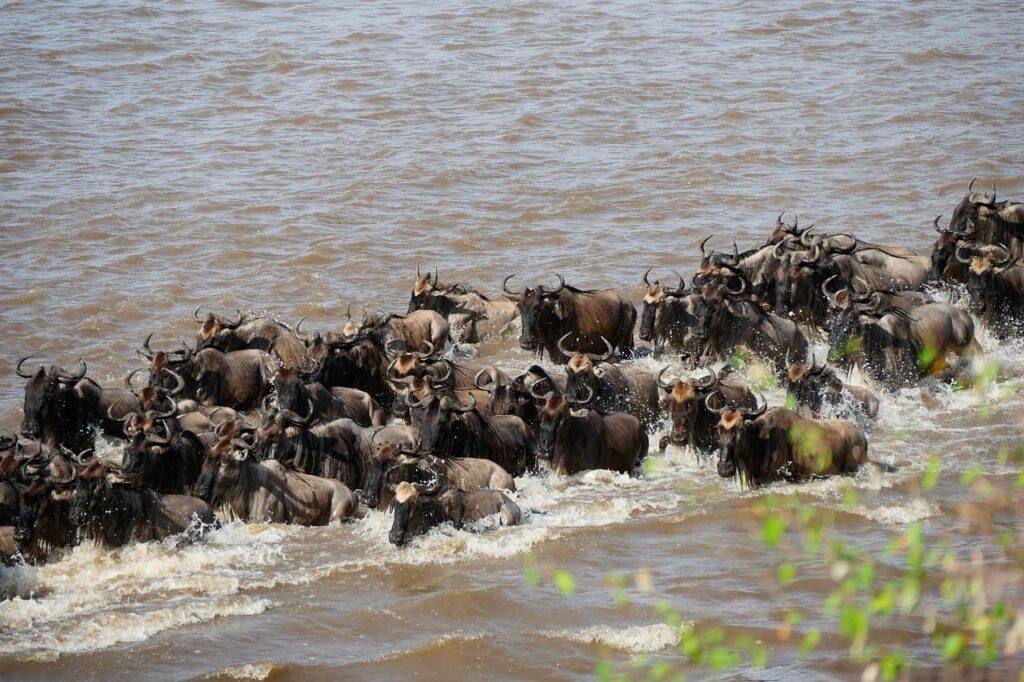
If the question of when to visit Serengeti has a single most compelling answer, it is this: follow the migration. The Great Migration is the largest overland movement of mammals on Earth a perpetual, thundering circuit across the Serengeti Mara ecosystem that follows the rains in an eternal, instinct-driven arc.
In the short-grass plains of the southern Serengeti and the Ndutu region, the wildebeest begin calving in late January, with roughly 8,000 calves born per day at the season’s peak. It is one of the most extraordinary and brutal spectacles in the natural world. Lions, cheetah, leopard, and hyena shadow the herds relentlessly. Visibility is outstanding on the open plains, and the light at this time of year is warm, golden, and perfect for photography. This is the quiet luxury moment most visitors overlook.
As the rains build in April, the herds begin their long northward march toward the central Serengeti. This is the green season dramatically lush, cinematically beautiful, and significantly quieter. Safari camps offer their best rates of the year. For a couple seeking complete privacy on the plains, there is arguably no better time.
By June, the massive columns of wildebeest have reached the Western Corridor and must cross the Grumeti River home to enormous, prehistoric crocodiles waiting in the shallows. The river crossings here are often overlooked in favour of the Mara, but they are equally dramatic and far less crowded. The dry season begins in earnest: skies sharpen, vegetation thins, and game concentrates with magnificent intensity.
The Mara River crossings in the northern Serengeti are what photographers and wildlife enthusiasts dream of. From July through October, hundreds of thousands of animals face the crossing in surges of pure instinct, churning the water into foam as crocodiles erupt from the surface. This is peak season camps fill quickly, and for good reason. Book 12–18 months in advance for the best-positioned luxury tented camps.
Use this quick-reference guide to match your travel dates to the Serengeti's rhythms.
| Month | Season | Migration Highlight | Rating |
|---|---|---|---|
| January | Short dry / Calving begins | Calving on Ndutu Plains — dramatic predator action | PEAK |
| February | Short dry / Peak calving | Up to 8,000 calves born daily, cheetah hunting at best | PEAK |
| March | Long rains begin | Herds begin northward march through central Serengeti | GOOD |
| April | Long rains (peak) | Western Corridor — green season seclusion | VALUE |
| May | Long rains (easing) | Herds mass near Grumeti River | VALUE |
| June | Dry season begins | Grumeti River crossings — crocodile drama | GOOD |
| July | Peak dry season | Mara River crossings begin — peak spectacle | PEAK |
| August | Peak dry season | Continuous Mara crossings — prime predator activity | PEAK |
| September | Dry season | Mara crossings continue, herds in northern Serengeti | PEAK |
| October | Dry season / Short rains start | Herds begin southern return — excellent open plains drives | GOOD |
| November | Short rains | Herds dispersing south — excellent birding | GOOD |
| December | Short rains easing | Herds returning to southern Serengeti — festive season | GOOD |
The question of when to visit Serengeti is inseparable from where you stay because the best luxury camps are positioned deliberately to put you in the heart of whatever seasonal drama is unfolding.
For the calving season, mobile camps and intimate tented lodges in the Ndutu Conservation Area and southern Serengeti place you directly on the calving grounds. Wake before dawn, and within minutes your guide will position you amidst a scene of breathtaking, primal intensity.
A handful of exclusive camps overlooking the Grumeti River offer private-reserve access during the river crossing season with none of the vehicle congestion that can affect the Mara region. This is where the true connoisseur of African safari gravitates.
The northern Serengeti particularly the Lamai Wedge and Kogatende area sits directly above the Mara River’s most dramatic crossing points. A well-positioned luxury tented camp here, with a private kopje sundowner deck, offers front-row access to one of Earth’s greatest natural events.
The best time to visit Serengeti depends on what you want to see. For the Great Migration river crossings, July–October is unmissable. For the calving season with dramatic predator action, visit in January–February. For luxury seclusion at lower rates, March–May (the green season) is exceptional.
Yes. The long rains (March–May) bring afternoon showers but rarely disrupt morning game drives. Many roads remain accessible with 4WD vehicles. The green season is safe, beautiful, and far less crowded it’s simply a different, more intimate experience than the dry season.
The wildebeest herds are present in the Serengeti ecosystem throughout the year the migration is a continuous cycle, not a one-time event. What changes is their location and the specific drama unfolding: calving in the south in January–February, river crossings in the north in July–October. Visit at any time, and you will witness something extraordinary.
Neutral-coloured clothing in khaki, olive, and tan is ideal. Layers are essential — mornings and evenings can be surprisingly cool, while midday is warm. A quality wide-brimmed hat, UV-protective sunglasses, binoculars (8×42 or 10×42 magnification), and a dust-proof camera bag are essential. Your lodge will advise on any seasonal specifics.
Our expert guides will help you choose the perfect time for your luxury Tanzania experience tailored to your travel dates, interests, and budget.
Talk to Us